Evaluating the Yin Yang Academy School Logo Vector: A Guide to Symbolism, Scalability, and Design Integrity
When educational institutions seek to establish a visual identity that balances tradition with modernity, the choice of logo format becomes as critical as the design itself. The Yin Yang Academy School Logo Vector represents more than just a graphic file; it is a strategic asset for branding consistency across diverse media. For administrators, designers, and stakeholders evaluating brand resources, understanding the technical and aesthetic implications of this specific vector illustration is essential. This analysis explores the distinct characteristics of the design, particularly its integration of academic motifs like the toga and hat, and compares vector-based approaches against other common formats to help you make an informed decision.
The Strategic Value of Vector Formats in Educational Branding
The term "vector" refers to a method of creating digital images using mathematical equations rather than pixels. Unlike raster images (such as JPEGs or PNGs), which can become pixelated when enlarged, a Yin Yang Academy School Logo Vector maintains crisp edges and perfect clarity at any size. This scalability is paramount for schools that need their branding to look professional on everything from small social media avatars to large banners hanging in gymnasiums or on the sides of buses.
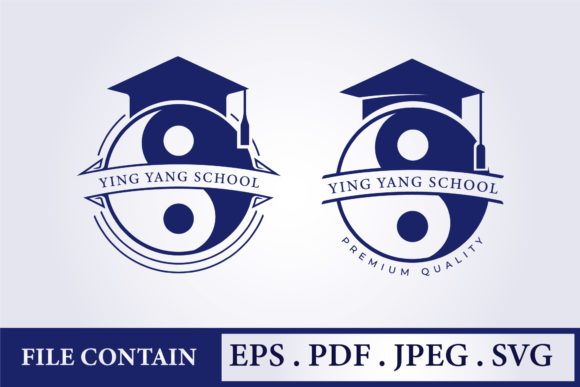
For the Yin Yang Academy, the use of a vector format ensures that the intricate details of the design remain sharp. The interplay between the black and white halves of the yin-yang symbol requires precise curves to convey balance and harmony. In a raster format, these curves might appear jagged on high-resolution displays or large prints. By opting for a vector file, typically in SVG, AI, or EPS formats, the institution guarantees that the visual integrity of the logo is preserved regardless of the output medium. This technical advantage translates directly into perceived professionalism and attention to detail.
Analyzing the Design Elements: Toga, Hat, and Duality
The specific illustration design associated with the Yin Yang Academy incorporates classical academic symbols—the toga and the graduation cap—within the framework of the yin-yang symbol. This combination is not merely decorative; it serves a narrative purpose. The toga represents historical wisdom, tradition, and the roots of Western education, while the yin-yang symbol introduces concepts of balance, holistic learning, and Eastern philosophical influences.
When evaluating this yin yang academy school logo vector illustration design toga hat, one must consider how these elements interact. The curvature of the toga often mirrors the swoop of the yin-yang division, creating a sense of movement and fluidity. The graduation cap, typically placed prominently, anchors the design in academic achievement. This fusion appeals to a broad demographic of parents and students who value both rigorous traditional education and a balanced, mindful approach to learning. However, the complexity of combining these three distinct symbols requires careful execution. If the lines are too thick or the details too minute, the logo may lose impact when scaled down. A well-executed vector design manages this trade-off by simplifying shapes without losing recognizability.
Comparing Vector Assets to Raster Alternatives
Many schools initially commission logos in raster formats because they are easier to create quickly using basic software. However, comparing a standard PNG or JPEG to the Yin Yang Academy School Logo Vector reveals significant long-term differences in utility and cost-efficiency.
- Scalability: As noted, vectors scale infinitely. Raster images have a fixed resolution. Enlarging a raster logo for a banner results in blurriness, requiring a redesign or re-commissioning of the asset.
- Editability: Vector files allow designers to easily change colors, adjust proportions, or isolate elements (such as removing the toga for a simplified icon). Raster files are flat images; changing a color requires complex selection tools and often results in uneven edges.
- File Size: For simple designs like the Yin Yang Academy logo, vector files are often smaller in file size than high-resolution raster images, making them faster to load on websites and easier to email.
While raster images are suitable for web-only use where dimensions are fixed, they lack the versatility required for a growing educational institution. Investing in a high-quality vector source file upfront prevents the need for costly redesigns later.
Decision Factors: When Is This Design the Right Fit?
Choosing the yin yang academy school logo vector illustration design toga hat depends on the institution's core values and target audience. This design is particularly effective for schools that emphasize:
- Holistic Education: Institutions that blend academic rigor with emotional or spiritual well-being will find the yin-yang symbolism resonant.
- Cultural Integration: Schools aiming to bridge Eastern and Western educational philosophies can use this logo to visually communicate their unique mission.
- Traditional yet Modern Appeal: The inclusion of the toga and hat signals respect for academic heritage, while the clean vector lines suggest modernity and precision.
However, there are scenarios where this design might not be the optimal choice. If a school prefers a minimalist, abstract identity without literal academic symbols, the detailed nature of the toga and cap may feel cluttered. Additionally, if the primary usage is strictly digital and small-scale (such as mobile app icons), the intricate details of the toga folds might need to be simplified further than the standard vector provides. In such cases, a secondary, simplified mark derived from the main vector might be necessary.
Implementation Best Practices for Maximum Impact
Owning the Yin Yang Academy School Logo Vector is only the first step. Proper implementation ensures the design achieves its intended effect. Designers should maintain adequate clear space around the logo to prevent visual clutter. Given the black-and-white nature of the yin-yang symbol, caution is needed when placing the logo on busy backgrounds. Using a reversed version (white on dark) or adding a subtle drop shadow can enhance visibility without compromising the design's elegance.
Furthermore, consistency in color application is crucial. While the core symbol is monochromatic, accompanying text or accents should adhere to a strict brand palette. The vector format facilitates this by allowing precise color code inputs (HEX, RGB, CMYK), ensuring that the logo looks identical on a printed brochure and a digital screen.
Conclusion: Making an Informed Choice
The yin yang academy school logo vector illustration design toga hat offers a compelling blend of symbolic depth and technical versatility. For educational leaders and designers, the decision to adopt this asset should be guided by an understanding of both its aesthetic message and its practical advantages. By choosing a vector format, institutions secure a flexible, future-proof brand element that can adapt to various media without loss of quality. While it may not suit every minimalist or ultra-modern brand strategy, for schools valuing balance, tradition, and holistic growth, this design provides a strong, coherent visual foundation. Evaluating your specific communication needs against the capabilities of this vector asset will ensure that your school’s identity is both meaningful and mechanically sound.